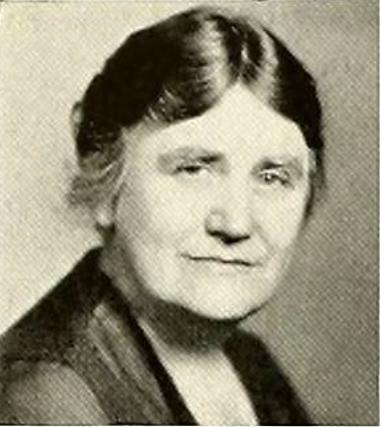
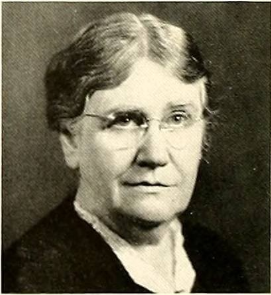
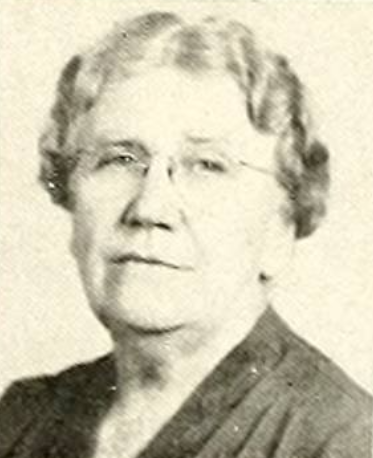
Click on photo to enlarge and view gallery.
Class of 1894
Graduation essay: “Troubled Waters Make the Sweetest Music”
Birth: 18 Jul 1878, Salem, Virginia
Death: 13 Feb 1957, Albemarle, Stanly County, North Carolina
Parents:
Robert Graham Kizer (1851 – 1933),
Cora Shipman Kizer (1856 – 1890)
Siblings:
Cora Lillian Kizer Patterson (1879 – 1975)
Annie Kizer Bost (1883 – 1981)
Alice Kizer Hatch (1888 – 1955)
Spouse: Thomas Edgar Johnston (1870-1957)
Marriage: 1897
Burial: Chestnut Hill Cemetery, Salisbury, Rowan County, North Carolina, USA
Source: www.findagrave.com, 85211823.
____________
Some Pioneer Women Teachers of North Carolina, by Delta Kappa Gamma Society, North Carolina, 1955, p. 107.
MABELLE KIZER JOHNSTON
Retired 1945
Mrs. T. Edgar Johnston’s professional career in teaching, supervising, and teacher training extended over a period of more than forty years. She was noted for her excellent teaching on whatever level her work happened to be. She served on various State Committees through which she made her influence felt. Perhaps she is best known for her organization and supervision of teacher training on the high school level as an emergency measure for the great teacher shortage during and immediately following World War I.
A native of Virginia, Mabelle Kizer, at the age of eight, moved with her parents to Salisbury, North Carolina. She completed the work offered in the Salisbury city schools and studied two years in Miss Jennie Caldwell’s private school. She continued her studies at Mont Amoena Seminary, a Lutheran Junior College located at Mount Pleasant, North Carolina. Later she received a degree from Catawba College.
In 1897, Miss Kizer was married to T. Edgar Johnston of Salisbury. However, her home duties did not interfere with her professional career. She had begun teaching as an assistant to her father, R. G. Kizer, who was Superintendent of the Salisbury City Schools and of Rowan County. Soon after her marriage, she began teaching in the Salisbury schools. Here she was fortunate to have had the supervision and inspiration of three of the State’s leading educators of that day who succeeded one another as head of the Salisbury schools: Charles L. Coon, I. C. Griffin, and A. T. Allen. Mrs. Johnston took advantage of the help of these leaders, also continued her studies through summer schools at the University of North Carolina, Columbia University, Peabody College, and Duke University.
She became very prominent in educational circles in the State. In 1917, E. C. Brooks, State Superintendent of Schools, appointed her as one of the six members of the State Board of Examiners and Institute Conductors. As a member of this board she had a voice in abolishing written examinations for teachers’ certificates, also in setting up six weeks summer schools for teacher training to replace the two weeks’ institutes previously held. For several years Mrs. Johnston served as one of the State Supervisors of County Summer Schools.
In the 1920s she did outstanding work in teacher training in the State.
Because of the lack of trained teachers to fill the public schools the Department of Education in 1910 established a plan of training teachers on the high school level. It continued this work with some modifications until 1929. After 1917 when the State took over the certification of all teachers a graduate of an accredited high school which offered teacher training was issued an Elementary Certificate. In the early 1920s Mrs. Johnston was supervisor of all schools where this work was being done. This was an arduous task. From sea coast on the east to Franklin on the west, she traveled visiting twenty-one schools where this work was being carried on. She offered encouragement and practical help to the instructors and inspired the students with ambition to do their best. In 1925 a regulation was passed by which admission to the teacher training departments was based upon high school graduation. Mrs. Johnston was instrumental in getting those in authority to allow college credit for a year’s work in these training centers. Not only did the project aid furnishing teachers to tide the State over an emergency, but numbers of students entered college, graduated, and went into the teaching profession. The personal testimony of these students was invariably; “What I am and what I have been able to do, I owe in large measure to Mrs. Johnston.”
In 1928 when Mrs. Johnston was about to leave this work, the instructors who had worked under her supervision showed their appreciation for her untiring efforts by giving her a life membership in the National Education Association.
Following her work as Supervisor of Teacher Training, Mrs. Johnston joined the staff of Catawba College as instructor in Education. Here she remained until her retirement in 1945. She still retains her interest in educational activities through contacts with former associates and students who seek her advice. She lives in Salisbury.
__________
The Catawba College (Hickory, NC) 2005-2006 Catalog, p. 44.
THE MABELLE KIZER JOHNSTON LOAN FUND was established at Catawba by former instructors of teacher training of the North Carolina State Department of Public Instruction in honor of Mrs. Mabelle Kizer Johnston, former director of this work. It is to be loaned to members of the senior class who are preparing to teach in the elementary grades in the public schools of North Carolina.
____________
The Salisbury Post (Salisbury, NC), 14 Feb 1957, p. 1.
Mrs. Johnston, Educator, Is Dead at 79
Mrs. T. Edgar Johnston, 79, died at 3:30 o’clock Wednesday afternoon at her home, 219 South Fulton Street. A heart attack followed several years of fragile health and some days of critical illness.
The body will be returned to the residence at 2:30 p.m. today.
Funeral services will be conducted Friday morning at 11 o’clock at St. John’s Lutheran Church, the Rev. James R. Stephenson officiating. Burial will be in Chestnut Hill Cemetery.
Immediate survivors include the widower and two sisters, Mrs. W. T. Bost of Raleigh and Mrs. Arthur L. Patterson of Albemarle. Surviving nephews are Robert Kizer Patterson and A. L. Patterson, Jr., of Albemarle, James J. Hatch, Jr., of Goldsboro, Thomas Bost, Jr., of Chapel Hill, and John S. Bost of Winston Salem. A niece surviving is Miss Cora Patterson of Albemarle.
Mrs. Johnston was born Maybelle Kizer at Salem, Va., and moved to Salisbury with her parents when she was eight years of age. Her father was Prof. Robert G. Kizer, a renowned educator who headed the Rowan County school system for 34 years. Her mother was Cora Shipman Kizer, daughter of a Salem minister.
Mrs. Johnston began her teaching career at Enochville when she was fewer than 20 years of age, and continued in educational work for nearly half a century.
Her career, as recorded in “Some Pioneer Teachers of North Carolina,: compiled by Delta Kappa Gamma of which she was a member, included classroom teaching at Salisbury following her Enochville tenure, and net, the position of primary supervisor for the schools here.
In 1917, she was appointed by Governor T. W. Bickett to the State Board of Examiners and Institute Conductors and served in that capacity for 11 years. She became a member of the faculty of Catawba College in 1930, and retired in 1945.
Mrs. Johnston was a lifelong member of St. John’s Lutheran Church, served on the Church Council, and taught the Woman’s Sunday School Class there for many years.
She was at one time President of the Salisbury Woman’s Club, and later headed the Educational Department of the North Carolina Federation of Women’s Clubs. She was a member of the North Carolina Educational Association, the Travelers Club, and the Christian Reid Book Club.
A graduate of Catawba College, she attended summer schools at the University of North Carolina, Duke University, Peabody College, the University of Knoxville, and Columbia University.
Mrs. Johnston was one of the best known and most beloved personalities in North Carolina education.
At the time of her retirement from Catawba College faculty in 1945, the Salisbury Post editorially summed up the widespread esteem in which she was held as follows:
As member of the state board of examiners and institute conductors created by the 1917 general assembly, her work of teaching teachers carried her to the uttermost parts of the state and moved her state leader, Dr. James Yadkin Joyner, to the ultimate in praise, “A great teacher,” Dr. Joyner, acknowledged prince of the pedagogues, pronounced her in her work with the state.
But people who know the value of a great tradition are exceptional if they can divest themselves of all proprietorship over it. It has been a rather slovenly habit of teachers as professionals who regard the schools as inventions to give their instructors employment. Mrs. Johnston’s father was persuaded by her to resign from his office when she and he concluded that a younger person could give the country schools a better superintendent than he could give them.
She has reached the same conclusion about herself and happily retires before anybody agrees with her. It probably cannot be agreed even now as to what are the great components of our pedagogy, but it is easy to believe that a teacher who so cheerfully detaches her own from the higher community interests must, in the vernacular, have what it takes.
The Post does not dare the mental gymnastics which would be necessary for any reasonably accurate estimate of how many people have personal and affectionate knowledge of just how positively Mrs. Johnston has “what it takes,” but they are many, and they run in uniform proportion among the hundreds of school people who have been associated with her and the thousands of students she has taught.
No resignation, no retirement can ever serve as exclamation mark of completion for a career of service such as the one with which Mrs. Johnston has blessed the world about her.
The true educator gives for generations to come, Impelled by spiritual necessity to teach, and endowed to sustain that impulse happily year after year, Mrs. Johnston, in whatever sphere of kindly wisdom, is assured of remaining an inspiration for all of her days regardless of the beginning or the ending of any school year or any specific assignment within that most noble of all spheres of human endeavor – the enlightenment of mankind.
____________
Stanly News and Press (Albemarle, NC), 15 Feb 1957, p. 4-A.
Sister of Local Resident Died on Wednesday
Mrs. T. E. Johnston, of Salisbury, sister of Mrs. A. L. Patterson, Sr., of Albemarle died Wednesday afternoon at 3:30 at her home
Mrs. Johnston had been in declining health for sometime and suffered a heart attack a few weeks ago.
She was the former Miss Mabel Kizer, daughter of the late Robert Graham Kizer and Cora Bell Shipman Kizer of Salisbury. She was active in St. John’s Lutheran Church in Salisbury.
Funeral rites will be held Friday at 11 a.m. at St. John’s Lutheran Church, conducted by Rev. James R. Stephenson.
Burial will follow at the Chestnut Hill Cemetery in Salisbury.
Mrs. Johnston had a wide background as an educator, having be educated in the Salisbury city schools and Catawba College at Salisbury. She was a teacher and supervisor in the Salisbury city schools for a number of years and was on the State Board of Examiners. At one time, she was assistant of professor of education at Catawba College.
Active in the civic life of Salisbury, she was a member of the Salisbury Woman’s Club; the Christian Reid Book Club, and the Traveler’s Club.
On numerous occasions Mrs. Johnston visited in Albemarle and was well known here.
Survivors include her husband T. Edgar Johnston; two sisters, Mrs. Arthur L. Patterson, Sr. of Albemarle and Mrs. W. T. Bost of Religh; five nephews and one niece.
____________
The Uplift, 25 Nov 1922, V. 11, No. 3. Published by the Stonewall Jackson Training and Industrial School (Concord, NC).
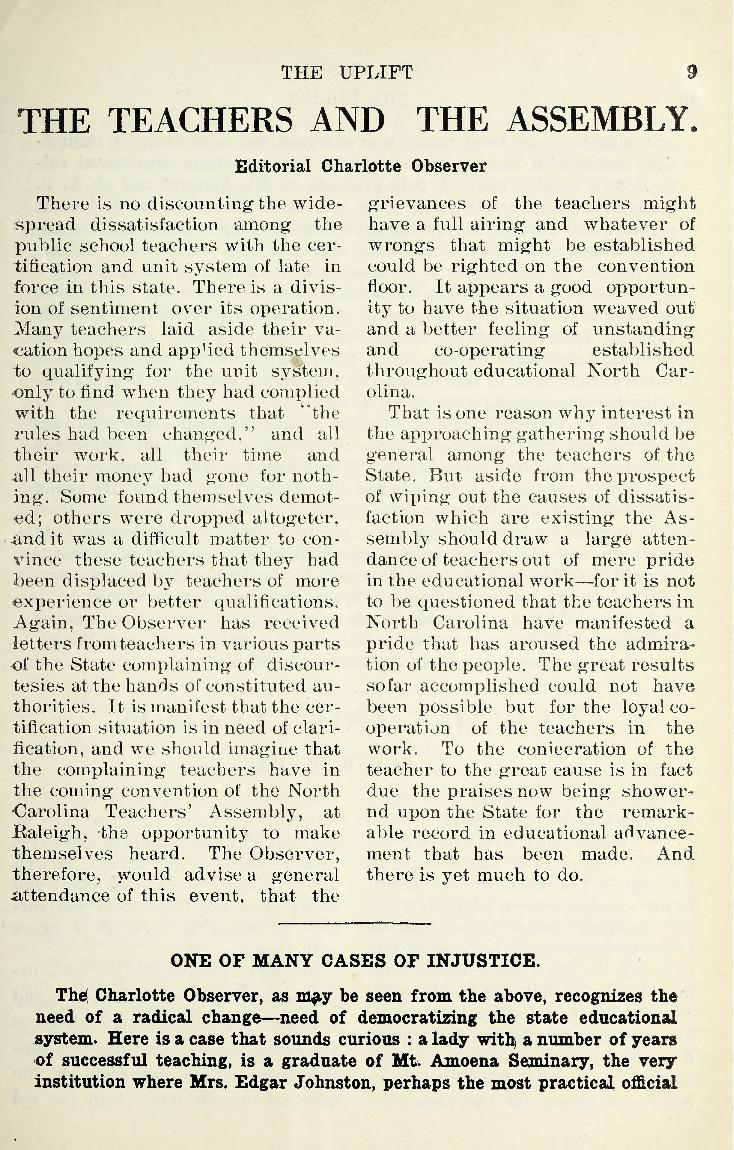
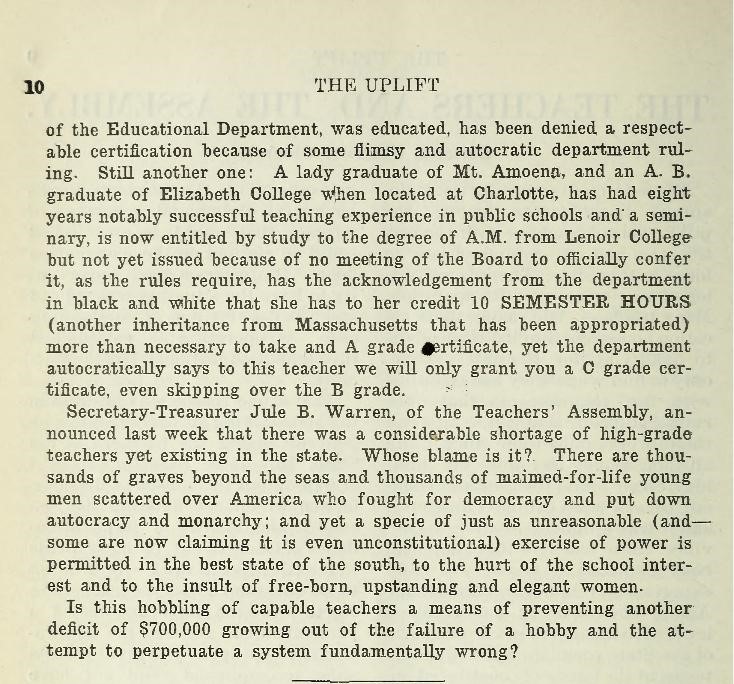
 Memories of Mont Amoena