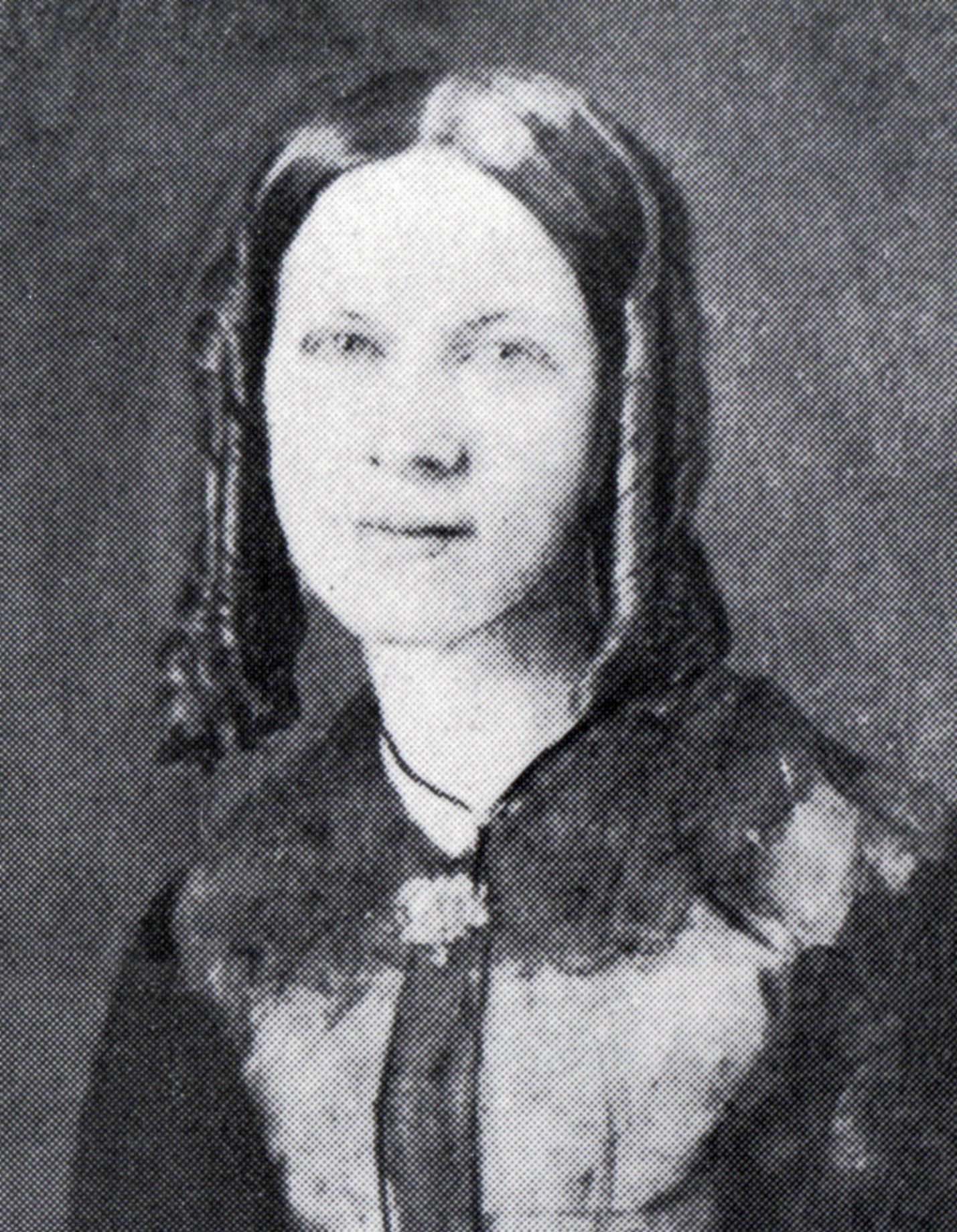
Susan Biglow Bittle, self portrait, c. 1860.
First Principal of Mount Pleasant Female Seminary, 1859-1860
Married to Rev. Daniel H. Bittle, Principal of Western Carolina Male Academy/North Carolina College 1853-1861.
Birth: 28 Nov 1828, Rochester, Plymouth County, Massachusetts
Death: 16 Oct 1907, San Luis Obispo, San Luis Obispo County, California
Parents:
Jonathan Biglow
Eliza Tappan Biglow
Spouse: Rev. Daniel Howard Bittle (c. 1819- 1874)
Married: 1849, Collamer, Ohio
Spouse: Rev. Abraham Myers (1828-1885)
Married: Nov. 1874, Indianapolis, Indiana
___________
LETTER FROM SUSAN BITTLE MYERS TO MRS. G. W. BOWMAN, 25 NOV 1897
____________
With the outbreak of the Civil War, Rev. Bittle requested dismissal from the North Carolina Lutheran Synod on October 8, 1861.
The Bittles decided it was best to leave North Carolina. The couple moved to Austin, Texas where they ran a school for young women until the end of the war. Rev. Bittle was again called to Roanoke College where he stayed two years, and then to Shepherdstown, West Virginia where he served four years. In October of 1871, he assumed charge of the Lutheran church in Savannah, Georgia, where he died on January 14, 1874 at the age of 54. In later years, Susan Bittle remarried and lived in San Francisco, California. After the death of her second husband, Rev. Abraham Myers, she continued with her art and work in the church, but lost everything in the great earthquake of 1906. She wrote in 1897 that, “The happiest part of my life was spent as Dr. Bittle’s wife, and in the dearly loved Southern states.”Susan Biglow Bittle Myers died in 1907 at the age of 78 in San Luis Obispo, California where she lived with her brother.
____________
The Concord Times (Concord, NC), 26 Jun 1906, p.3.
Mrs. Meyers Survives
EDITOR TIMES: Since the announcement some time ago that Mrs. Susan Bittle Meyers was probably lost in the great San Francisco disaster, news have reached friends that she escaped, though very narrowly. She was suffering from a fall and had been nursing her injured foot on a pillow. She could not get any help to move anything from the doomed home, and while they were dynamiting the houses around her she picked a suit case and plodded out, leaving all the valuable relics, including the fine large portrait of her first husband, Dr. D H Bittle, a specimen of her skill in the art of portraiture. She had $10 with her and was afoot from 7 a.m. to 10 p.m. carrying the suit case. She is now with her brother in another part of the State.
J. B. D.
Charlotte, N. C., June 25, 1906.
____________
Siskiyou Daily News (Yreka, CA), 24 Oct 1907, p. 2.
Obituary
The announcement in our mortuary columns of the death of Mrs. Susan Eustis Bittle Myers at the advanced age of 79 years recalls a brief review of a remarkably strenuous life just closed.
Mrs. Myers was born in Rochester, Plymouth county, Massachusetts, on November 28, 1828, to Rev. Jonathan Bigelow and his wife, Eliza Tappan. Educated at Mount Holyoke, Massachusetts, under the world-wide known instructor, Mrs. Lyon, at the age of 16 she graduated and entered Dr. Lyman Beecher’s newly established college at Cincinnati, Ohio, as musical instructor. At 18 she was married to Rev. Howard Bittle, a young Lutheran minister just graduated from the theological seminary, and with him assumed the labors and privations of a pioneer home missionary in the sparsely settled regions of Indiana and Illinois. Later the young couple were transferred to Salem and New Lisbon, Ohio, where Mrs. Bittle established schools for young ladies and taught with good success as principal. She had found her vocation and when later Rev. Mr. Bittle was called to Gettysburg and the middle counties of Pennsylvania she founded two young ladies seminaries and educated numberless young lady graduates who will doubtless recall their old preceptress. During the fifties Mr. Bittle was made professor at Roanoke college, Virginia, and Mrs. Bittle conducted a large female college in that connection.
Late in the fifties Mr. Bittle was called to the presidency of a southern college near Raleigh, North Carolina, (Mt. Pleasant I think), and until the civil war broke out Mrs. Bittle conducted the usual appanage of a female college as president and instructor to about 200 scholars. The war called all the college students from the college, some 250 strong, and the college was closed. President Bittle and Mrs. Bittle had to sacrifice almost all their property and had barely sufficient means to move to Texas where they founded a school for young ladies in one of the middle county towns near Houston, and there remained during the five years of civil strife. At the close of the war Mr. Bittle was called to be professor again at Roanoke college, Virginia, and after some months traveling in the northern cities they collected over $100,000 to add to the funds of the college. He occupied his professor’s chair till he was called to the pulpit of the large and wealthy church of Lutherans at Savannah, Georgia, where he preached till he was stricken down almost in harness with heart disease.
In 1871 Mrs. Bittle came to San Francisco to visit her brother, H. H. Bigelow, where she met Rev. Abram Myers, a Lutheran clergyman from Oregon, who had recently lost his wife by death and had six young children motherless on his hands who appealed to her mother heart for succor. Declining a very advantageous offer as president of a large female college at Gettysburg, Pennsylvania, she, at past 50 years, seemingly “called of God,” undertook the bringing up of the young family and married Rev. Abram Myers. They settled on a fruit ranch which she bought at Lower Springs, Shasta county, and for 15 years she educated this family of girls and boys up to maturity. They are all married and well settled in life.
In ’89 Rev. Myers died suddenly of heart disease. The children were all grown and Mrs. Myers removed to San Francisco where she acted as governess to several families till the earthquake and fire rendered her homeless and almost impoverished when she came to Yreka to visit her nephew, R. L. P. Bigelow, forest supervisor. In December, 1906, needing a milder climate, she moved to San Luis Obispo to the home of her niece, Mrs. E. S. Mainwaring. Her health had gradually been failing, having been in two bad accidents in recent years and she finally closed her long and active life on Wednesday, October 16, 1907. She was an active member of the order of the Eastern Star and had filled all the chairs of the subordinate and grand lodges. She was a gifted authoress, a fine musician and vocalist, an accomplished artist, devoted to the Lutheran church and a gifted botanist. While in Texas she painted a set of all the Texan flowers which Dr. Gray, the eminent botanist of Massachusetts, pronounced to be exhaustive, exact and the best collective work he had ever seen of its kind. This was burned up in the fire of San Francisco. This is a brief sketch of one woman’s busy life. She has heard ere this the “Well done, good and faithful servant. Enter thou into the joys of thy Lord.”
H. H. B.
____________
From Ben Callahan, Mount Pleasant, 5 Jan 2018
https://www.facebook.com/groups/1863029447342349/
I write this with apologies. In 1958 my father purchased the house in Mt. Pleasant designed by Susan Bigelow Bittle and built abt 1859-60. She and her husband lived in the house for only about two years before they left Mt.Pleasant. The house was solid, but the foundation was unsafe and my Dad could not get the financing to move the house. He decided to tear it down. No one knew much about how the house was built and to everyone’s amazement, the walls were built by stacking (flat sides down) hand hewn 2×4’s. The sections were connected by a kind of tongue & grooved system linking the stacked 2×4’s. Hand hewed nails were used. It was a fantastic design and everyone, including my Dad, regretted the loss. The ECHS museum has several photos of the house which later became a dorm for MPCI. There is an 1958 article in the Concord Tribune about the house being torn town (with photos). Copy is in George Hahn’s Eastern Cabarrus History.

History of the Bittle House in Mount Pleasant, designed by Susan Biglow Bittle in the 1850s. Winston-Salem Journal and Senitnel, Sept. 22, 1957.
____________
Memories of Mont Amoena Facebook.com group page.
By Denise Steward McLain

