From the Julia Ethelyn Crabtree McAllister Collection.

Concord Daily Tribune (Concord, NC), 16 May 1921, p. 1.
COMMENCEMENT PLAY
At Mt. Pleasant College This Year Will Be “The Lion and the Mouse.”
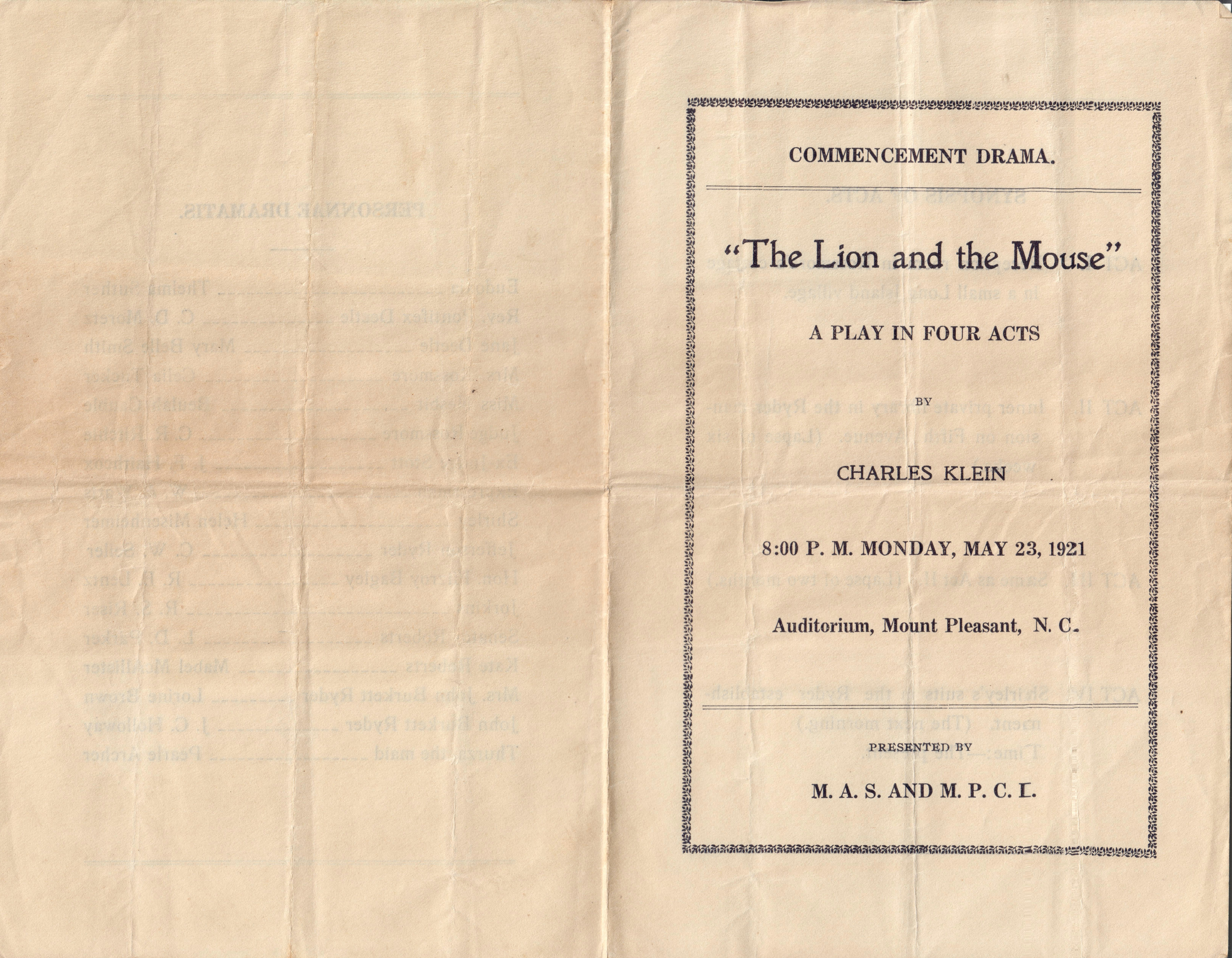
Charles Klein’s play, “The Lion and the Mouse,” will be produced in Mt. Pleasant, May 23rd, as the annual commencement drama of Mont Amoena Seminary and the Collegiate Institute. Every effort has been made to secure appropriate and artistic stage settings, and the very latest costumes handled by the well known firm of Van Horn & Son, Philadelphia, have also been engaged. The cast is large and the play itself is a very interesting story.
The first act introduces us to Judge Rossmore and his family in dire straits. The worthy Judge had crossed the path of the “system” and more than once, by his unimpeachable integrity, thwarted the plans of John Burkett Ryder and his associates. At last, however, the revenge of the moneyed powers has overtaken him. With devilish ingenuity they have inveigled him into financial transactions of which he understood little, and, without his knowledge, have made him over stock than he was entitled to, so as to expose him to the suspicion of having accepted a bribe. Then, in the critical moment, certain letters, especially one which he had written to Ryder and from which his innocence would have been clearly established, are withheld from his friends and legal adviser, ex-Judge Stott. His fortune is shattered, he faces impeachment, and, the Senate Committee being but a tool in Ryder’s hands, almost certain conviction.
When his daughter, Shirley, returns from a pleasure trip to Europe, in the course of which she had accidentally met and learned to love Ryder’s son, Jefferson, she finds her family’s social status totally changed and disgrace hanging over her father’s head. Shirley is not only a brave but a clever woman. She had, under the name of Sarah Green, published a book of stories, and but recently completed a novel, “The Octopus,” for which the fascinating if unsympathetic figure of Ryder had been the model. Jefferson, the son, has not read the novel and knows nothing of Shirley’s literary work. When he hears that her father is in difficulties he at once asks her for her hand. She had given him some encouragement, but rejects his offer under the circumstances. The announcement of Jefferson’s engagement to Kate Roberts, daughter of Senator Roberts, which had been published simultaneously with young Ryder’s return—without his knowledge and against his will, but in accordance with his father’s commands—and the unenviable part which the older Ryder had borne in bringing about Judge Rossmore’s downfall, supply her with a plausible excuse. She will have justice for her father, and before the end has been attained she will hear nothing of love. Throughout this act as well as throughout the play Shirley reveals a strong, self-reliant soul.

