Click on images to enlarge.
-
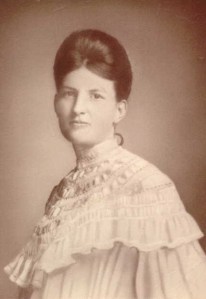
- Rosa Irene Powlas, c. 1900; raufme, Ancestry.com..
-
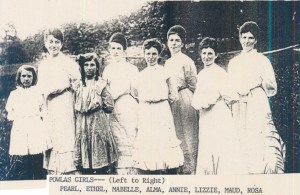
- Powlas sisters, c. 1905; raufme, Ancestry.com.
-
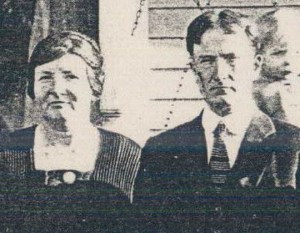
- Rosa and William Lee Ezzell, 1925 family reunion, Hickory, NC; raufme, Ancestry.com.
-
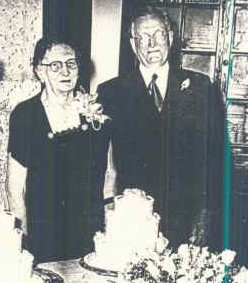
- Rosa Irene Powlas and husband William Lee Ezzell on their 50th anniversary, 1956; raufme, Ancestry.com.
Class of 1900
Birth: 6 Nov 1880, Barber, Rowan County, North Carolina
Death: 28 Sep 1957, Concord, Cabarrus County, North Carolina
Parents:
John William Powlas (1856-1899)
Margaret Victoria Miller Powlas (1859-1942)
Siblings:
Margaret Elizabeth “Lizzie” Powlas Boland (1882-1983)
Mary Alma Powlas Whitener (1884-1968)
Genolia Ethel Powlas Aderholt (1886-1964)
Maud Olena Powlas (1889-1980)
Annie Pauline Powlas (1891-1978)
Mabel Lucile Powlas Gilbert (1893-1982)
Pearl Miller Powlas Dunkelberger (1897-1956)
Spouse: William Lee Ezzell (1878-1961)
Marriage: 8 May 1906, Rowan County, North Carolina
Children:
Wendell Linn Ezzell (1907-1988)
Rosa Estelle Ezzell Sewell (1909-1988)
Lauriston Lee Ezzell (1912-1972)
Blandina Ezzell Webster (1914-1961)
John William Ezzell (1918-1987)
Naomi Eloise Ezzell Stump (1921-2004)
Burial:
Oakwood Cemetery, Concord, Cabarrus County, North Carolina, USA
Source: www.findagrave.com, # 87701292.
Comment:
Edith Boland Eubanks (7 Sep 2017): “My Paternal Grandmother, Margaret Elizabeth “Lizzie” Powlas Boland, and her older sister, Rosa Irene Powlas Ezzell, attended and graduated from Mont Amoena. I heard my Grandmama talk fondly about her days there as long as she lived.”
____________
Descendants of Johann Wilhelm Paulas (1721-1785) and Barbara, Presented to the 1998 Annual Powlas Family Reunion, Bernard W. Cruse, Jr., (1998), p.12. http://www.familysearch.org.
ROSA’S ILLNESS – by Naomi Ezzell Stump
To say Rosa got differential treatment at Mt. Amoena Seminary because her mother was still remembered as Miss Miller, a teacher at the school, when it was known as “Captain Fisher’s School for Young Ladies” was never admitted but she believed that was the reason she was chosen to make the trip with the music club to visit a Lutheran church called “Organ Church” located some distance from the school. This was a highly coveted honor among the students for not only was it a day’s travel in the countryside, but the church owned the only real organ in the area. It was carved and built by a musician. Dr. Stirewalt, who built this one and only in his home.
The girls were eager to get started. Even though the sun was just beginning to show and the little wisps of fog wavered in the low spots in the lawn. The wagons were lined up before the school and the attendants were adding the last of the needed supplies. The wagons were necessary for the supplies and also for the students since the school owned only one carriage which was used for the faculty. The trip was slow because of the frequent stops for various reasons. Water was a great concern because of the present typhoid fever epidemic and stops for water were only made at schoos and churches where the water was known to be safe.
The small, tired, dusty entourage arrived at the church late in the afternoon where the congregation greeted them with the customary “dinner on the grounds.” Long tables with spotless white cloths were set up under the big oak trees beside the church and each family had brought huge hampers of food. Each brought enough for their family dinner and at least ten other people. Since there were only 12 in the group from the school, there was an abundant spread. There were large platters of baked ham, fried ham and ham biscuits, fried and baked chicken, everyone’s favorite cakes and pies and every kind of pickled fruit and vegetable known to the area (the church dinners were where all housewives showed their skills). It was a nice custom for when everyone had eaten the remaining food was exchanged among the families so they had a variety for weeks and many recipes were shared.
After dinner the girls were sent to various homes to dress for their performance – their evening of music. The service started with the people in the church singing. Unkind thoughts kept running through Rosa’s head — I don’t usually try to sing in church — to try to hear your own voice, or to try to sing with them — I don’t know — I sort of get lost and the sound makes one big voice only it’s rusty and tight like an old machine. They sing all verses and they never get it right. One woman kept singing too loud — she will try and try until the organ plays it her way — Oh, I wish I were home at the farm where it is quiet —
The girls’ part of the program went well and they were praised highly. Then offered food again. Finally Rosa was sent to spend the night with an old couple who had a daughter with a lingering illness. She was thin and weak. Rosa thought — her skin is yellow like old paper — like Grandpa’s old discharge paper from the Confederate Army that is in Papa’s old black chest.
After the trip weeks passed and the school fell into the usual routine but Rosa began to feel ill and complained of soreness in her side. The “Housemother” gave it little thought until one morning when Rosa woke and the girls said her eyes were yellow. Immediately the faculty were trying to contact her family so they could get her out of the school. Knowing she could not travel the 40 miles to her home, they put her in a bed made in the bottom of a wagon and took her to Concord, a mere 9 miles, to her aunt, Mrs. Irene Miller. Her uncle, Rev. Charlie Miller was at that time minister in the Lutheran church. Rosa stayed at the Millers’ for six weeks under the care of Dr. Young, who gave them no encouragement as to her ever being well again. But with her Aunt Irene’s care and Dr. Young’s treatment of the “hardening of the liver” known as being very rare at that time. She was able to go home in Uncle Charlie’s carriage. The disease she had is now known as hepetitas and she had been sick eight weeks.
On May 8, 1906, Rosa and her sister Lizzie (Margaret Elizabeth) married their grooms in a double wedding at Lebanon Lutheran church near the old family homeplace. The train stopped on the tracks beside the church to allow the guests to get off to attend the wedding ceremony. Two days later, on May 10th, there came a killing frost that killed everything, even the cotton. Until their passing, the old timers talked of that killing frost. About 1940 the state improved the road (US29) between Concord and Salisbury. Rosa, a rather dignified matron by that time, was used to the old 55 mile per hour speed limit, but simultaneously with completing the new four lane road, the state had imposed a new 45 mile per hour limit. Driving along in her almost-new Packard at 55, suddenly she encountered the red lights and a siren of a highway patrolman. “Where’s the fire, Grandma?” he queried as he strode up to her open window. Indignantly, she replied, “Grandma? I’m not your grandmother!” Apparently the patrolman was so non-plussed he did not give her a citation. Lee told the story that at one time they had a couple of heifers. One of them particularly annoyed Rosa, as every time she went to the barn lot, it would kick and butt at her, so one morning she told her husband, “Lee, I want you to kill that light heifer before you go to work.” When he came home, she was beside herself; he had killed the wrong one. “Well,” he answered, “I hefted both of them and killed the lightest one.”
____________
Hickory Daily Record, 28 Sep 1957, p. 11.
DEATH CLAIMS MRS. EZZELL, 76
CATAWBA – Mrs. Rosa Powlas Ezzell, 76, wife of Dr. W. L. Ezzell of Concord and sister of two Lutheran missionaries from Japan now on furlough and visiting another sister, Mrs. C. B. Gilbert, in Catawba, died early this morning in a Concord hospital after a lingering illness.
Funeral arrangements are incomplete at this time but it is expected that burial will be made in Concord.
Mrs. Ezzel attended Lenoir Ryne college, and has lived most of her life in Concord.
In addition to her husband, she is survived by three daughters, Mrs. Charles Webber of goldsboro, Mrs. James Sewell of Stillwater, Okla., and Miss Naomi Eloise Ezzell of Danville, Va.” three sons, Dr. L. L. Ezzell of Andrews, and Dr. Wendell Ezzell and Dr. J. William Ezzell of Concord; six sisters, Misses Annie and Maud Powlas who are the missionaries to Japan, Mrs. Gilbert, Mrs. Ed R. Whitener of Newton, Mrs. L. P. Boland of Cleveland, and Mrs. O. W. Aderholdt of Salisbury; and a number of grandchildren.
 Memories of Mont Amoena