Stella Blanche Hahn, a 1918 graduate, wrote this graduation essay, titled The Function of the Church’s Bible School, that same year. Click on the images to enlarge. A transcription follows. Courtesy of great-nephew, Joel Walters.
Handwritten copy:

Typewritten copy:

Transcription:
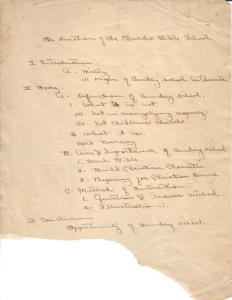
THE FUNCTION OF THE CHURCHS BIBLE SCHOOL.
Handwritten: Senior Essay (1918–19)
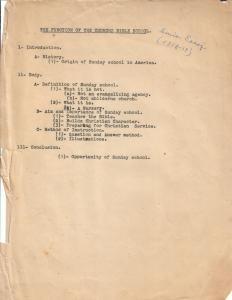
Outline
I—Introduction.
A—History.
(1)—Origin of Sunday school in America.
II—Body.
A—Definition of Sunday school.
(1)—What it is not.
(a)—Not an evangelizing agency.
(b)—Not childrens church.
(2)—What it is.
(a)—A Nursery.
B—Aim and Importance of Sunday school.
(1)—Teaches the Bible.
(2)—Builds Christian Character.
(3)—Preparing for Christian Service.
C—Method of Instruction.
(1)—Question and Answer method.
(2)—Illustrations.
III—Conclusion.
(1)—Opportunity of Sunday school.
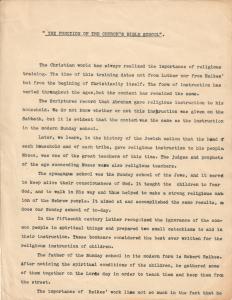
“THE FUNCTION OF THE CHURCH’S BIBLE SCHOOL”
The Christian world has always realized the importance of religious training. The time of this training dates not from Luther nor from Raikes’ but from the begining of Christianity itself. The form of instruction has varied throughout the ages, but the content has remained the same.
The Scriptures record that Abraham gave religious instruction to his household. We do not know whether or not this instruction was given on the Sabbath, but it is evident that the content was the same as the instruction in the modern Sunday school.
Later, we learn, in the history of the Jewish nation that the head of each household and of each tribe, gave religious instruction to his people. Moses, was one of the great teachers of this time. The judges and prophets of the age succeeding Moses were also religious teachers.
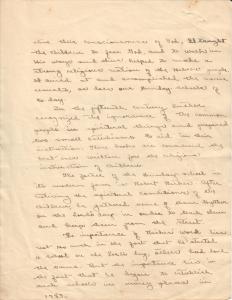
The synagogue school was the Sunday school of the Jews, and it served to keep alive their consciousness of God. It taught the children to fear God, and to walk in His way and thus helped to make a strong religious nation of the Hebrew people. It aimed at and accomplished the same results, as does our Sunday school of to-day.
In the fifteenth century Luther recognized the ignorance of the common people in spiritual things and prepared two small catechisms to aid in their instruction. These books are considered the best ever written for the religious instruction of children.
The father of the Sunday school in its modern form is Robert Raikes. After noticing the spiritual conditions of the children, he gathered some of them together on the Lords day in order to teach them and keep them from the street.
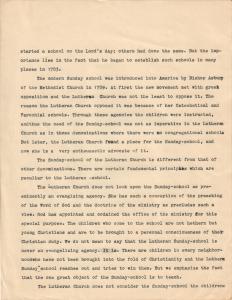
The importance of Raikes’ work lies not so much in the fact that he started a school on the Lord’s day; others had done the same. But the importance lies in the fact that he began to establish such schools in many places in 1783.
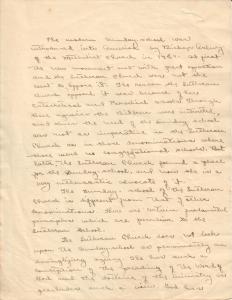
The modern Sunday school was introduced into America by Bishop Asbury of the Methodist Church in 1789. At first the new movement met with great opposition and the Lutheran Church was not the least to oppose it. The reason the Lutheran Church opposed it was because of her Catechetical and Parochial schools. Through these agencies the children were instructed, and thus the need of the Sunday-school was not as imperative in the Lutheran Church as in those denominations where there were no congregational schools. But later, the Lutheran Church found a place for the Sunday-school, and now she is a very enthusiastic advocate of it.
The Sunday-school of the Lutheran Church is different from that of other denominations. There are certain fundemental principles which are peculiar to the Lutheran-school.
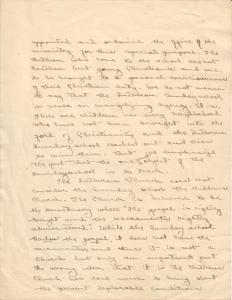
The Lutheran Church does not look upon the Sunday-school as preeminently an evangizing agency. She has such a conception of the preaching of the Word of God and the doctrine of the ministry as precludes such a view. God has appointed and ordained the office of the ministry for this special purpose. The children who come to the school are not hethern but young Christians and are to be brought to a personal consciousness of their Christian duty. We do not mean to say that the Lutheran Sunday-school is never an evangelizing agency. It is. There are children in every neighborhood who have not been brought into the fold of Christianity and the Lutheran Sunday-school reaches out and tries to win them. But we emphasize the fact that the one great object of the Sunday-school is to teach.
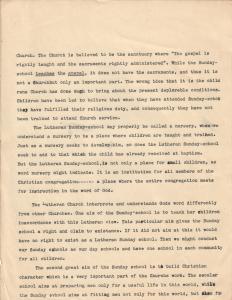
The Lutheran church does not consider the Sunday-school the childrens Church. The Church is believed to be the sanctuary where “The gospel is rightly taught and the sacraments rightly administered”. While the Sunday-school teaches the gospel, it does not have the sacraments, and thus it is not a Church but only an important part. The wrong idea that it is the childrens Church has done much to bring about the present deplorable conditions. Children have been led to believe that when they have attended Sunday-school they have fulfilled their religious duty, and consequently they have not been trained to attend Church service.
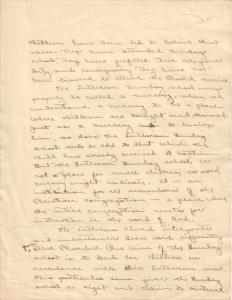
The Lutheran Sunday-school may properly be called a nursery, when we understand a nursery to be a place where children are taught and trained. Just as a nursery seeks to develop him, so does the Lutheran Sunday-school seek to add to that which the child has already received at baptism. But the Lutheran Sunday-school, is not only a place for small children, as word nursery might indicate. It is an institution for all members of the Christian congregation— a place where the entire congregation meets for instruction in the word of God.
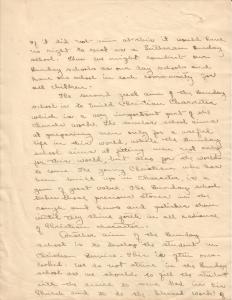
The Lutheran Church interprets and understands Gods word differently from other Churches. One aim of the Sunday-school is to teach her children in accordance with this Lutheran view. This particular aim gives the Sunday school a right and claim to existance. If it did not aim at this it would have no right to exist as a Lutheran Sunday school. Then we might conduct our Sunday schools as our day schools and have one school in each community for all children.
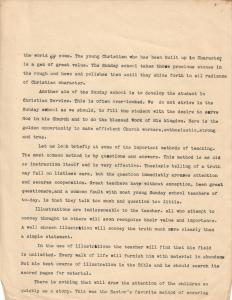
The second great aim of the Sunday school is to build Christian character which is a very important part of the Churchs work. The secular school aims at preparing men only for a useful life in this world, while the Sunday school aims at fitting men not only for this world, but also for the world to come. The young Christian who has been built up in Character is a gem of great value. The Sunday school takes those precious stones in the rough and hews and polishes them untill they shine forth in all radiance of Christian character.
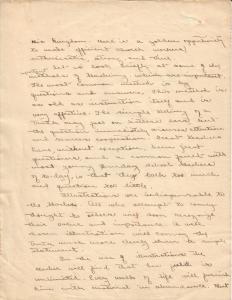
Another aim of the Sunday school is to develop the student in Christian Service. This is often over-looked. We do not strive in the Sunday school as we should, to fill the student with the desire to serve God in his Church and to do the blessed Work of His kingdom. Here is the golden opportunity to make efficient Church workers, enthusiastic, strong and true.
Let us look briefly at some of the important methods of teaching. The most common method is by questions and answers. This method is as old as instruction itself and is very effective. The simple telling of a truth may fall on listless ears, but the question immediatly arouses attention and secures cooperation. Great teachers have without exception, been great questioners, and a common fault with most young Sunday school teachers of to-day, is that they talk too much and question too little.
Illustrations are indispensable to the teacher. All who attempt to convey thought to others will soon recognize their value and importance. A well chosen illustration will convey the truth much more clearly than a simple statement.
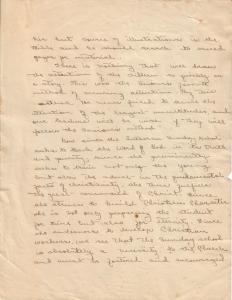
In the use of illustrations the teacher will find that his field is unlimited. Every walk of life will furnish him with material in abundance. But his best source of illustration is the Bible and he should search its sacred pages for material.
There is nothing that will draw the attention of the children so quickly as a story. This was the Savior’s favorite method of securing attention. By this method He never failed to secure the attention of the largest multitudes, and our teachers will be wise if they will follow the Savior’s method.
Now since the Lutheran Sunday school seeks to teach the Word of God in its truth and purity; since she preeminently seeks to train not only the young, but also the adult in the fundamental facts of Christianity, she thus fulfills the great command of Christ. Since she strives to build Christian Character she is not only preparing the student for time but also for eternity. Since she endeavors to develop Christian workers, we see that the Sunday-school is absolutely a necessity, to the Church and must be fostered and encouraged.

