Stella Blanche Hahn, a 1918 graduate, wrote this essay, titled Martin Luther and the Reformation, that same year. Although dated 1918, it was not her graduation essay. Click on the images to enlarge. A transcription follows. Courtesy of great-nephew, Joel Walters.
Transcription:
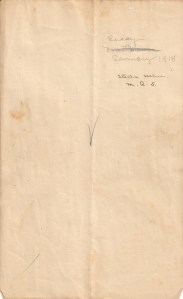
Cover
Essay
Seminary 1918
Stella Hahn.
M. A. S.
____________
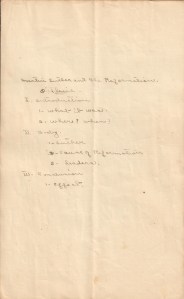
Outline
Martin Luther and The Reformation.
I. Introduction
- What it was.
- Where? When?
II. Body
- Luther
- Cause of Reformation
- Leaders.
III. Conclusion
- Effect.
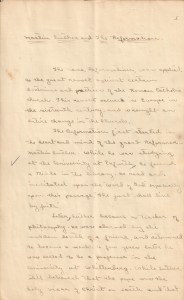
Martin Luther and The Reformation
The name, Reformation, was applied to the great revolt against certain doctrines and practices of the Roman Catholic Church. This revolt occurred in Europe in the sixteenth century, and wrought an entire change in the Church.
The Reformation first started in the heart and mind of the great Reformer—Martin Luther. While he was studying at the University at Erfurth, he found a Bible in the library. He read and meditated upon the “word of God” especially upon this passage, “The just shall live by faith.”
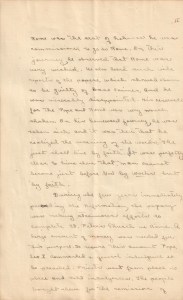
Later, Luther became a teacher of philosophy. He was alarmed by the sudden death of a friend, and determined to become a monk. A few years later he was called to be a professor in the University at Wittenberg. While Luther still believed that the pope was the holy vicar of Christ on earth and that Rome was the seat of holiness he was commissioned to go to Rome. On this journey he observed that Rome was very wicked. He also heard such vile reports of the popes, which showed them to be guilty of base crimes, and he was miserably disappointed. His reverence for the Pope and Rome was very much shaken. On his homeward journey, he was taken sick and it was then that he realized the meaning of the words, “The just shall live by faith.” It was perfectly clear to him then that, “man cannot become just before God by works but by faith.”
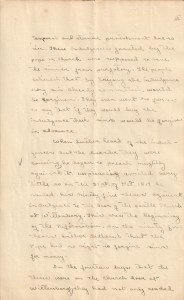
During the few years immediately preceding the Reformation, the papacy was making strenuous efforts to complete St. Peter’s Church in Rome. A large amount of money was needed for this purpose. To secure this amount Pope Leo X commanded a general indulgence to be preached. Priests went from place to place and sold indulgences. The people bought them for the remission of temporal and eternal punishment due to sin. These indulgences granted by the pope or Church were supposed to save the sinner from purgatory. The people believed that by buying the indulgence every sin already committed, would be forgiven. They even went so far as to say that if they would buy the indulgence their sins would be forgiven in advance.
When Luther heard of the indulgences and the disorder they were causing, he began to preach mightily against it. His preaching availed very little so on the 31st of Oct. 1517 he nailed his ninety five theses against indulgence to the door of the castle Church at Wittenberg. This was the beginning of the Reformation. In the ninety five theses Luther declared that the Pope had no right to forgive sins for money.
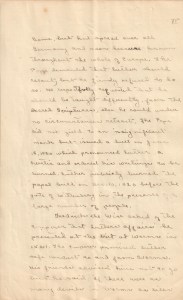
In the fourteen days that the theses were on the Church door at Wittenberg, they had not only reached Rome, but had spread over all Germany and soon became known throughout the whole of Europe. The Pope demanded that Luther should recant, but he firmly refused to do so. He repeatedly requested that he should be taught differently, from the Sacred Scriptures, else he could under no circumstances retract. The Pope did not yield to an insignificant monk but issued a bull on June 15, 1520 which pronounced Luther a heretic and ordered his writings to be burned. Luther publicly burned the papal bull on Dec. 10, 1520 before the gate of Wittenberg in the presence of a large number of people.
Frederick the Wise asked of the Emperor that Luther’s affairs be presented at the Diet at Worms in 1521. The Emperor promised Luther safe conduct to and from Worms. His friends advised him not to go but he said, “If there were as many devils in Worms as tiles on the roofs, I would still go thither,” and trusting in his God he proceeded to go on his journey.
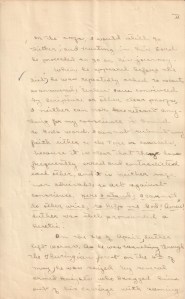
When he appeared before the diet, he was repeatedly asked to recant. He answered, “Unless I am convinced by Scripture or other clear proofs, I neither can nor dare retract anything for my conscience is bound to God’s word. I cannot submit my faith either to the Pope or councils, because it is clear that they have frequently erred and contradicted each other, and it is neither safe nor advisable to act against conscience. Here I stand; I cannot do otherwise; so help me God! Amen!” Luther was still pronounced a heretic.
On the 26 of April, Luther left Worms. As he was traveling through the Thuringian forest on the 4th of May, he was seized by several armed knights who dragged him out of his carriage with seeming violence, threw a military cloak over his shoulders and placing him on a horse, in a few moments vanished with him in the gloomy forest. They rode on until they reached Wartburg at eleven o’clock that night. Here he was kept in a place of safety until the first storm had subsided.
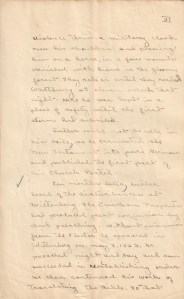
Luther could not be idle in his exile, so he translated the New Testament into pure German and published the first part of his Church Postil.
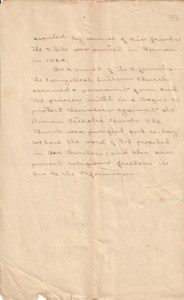
Ten months later, Luther heard of the disturbances at Wittenberg. The Zwickau Prophets had produced great confusion by their preaching. Without permission from the Elector he appeared in Wittenberg on May 3, 1522. He preached night and day and soon succeeded in reestablishing order. He then continued his work of translating the Bible. So that assisted by several of his friends the Bible was printed in German in 1524.
As a result of the Reformation the Evangelical Lutheran Church assumed a permanent form and the princes united in a league to protect themselves against the Roman Catholic Church. The Church was purified and to-day, we have the word of God preached in our Churches, and also our present religious freedom is due to the Reformation.
 Memories of Mont Amoena